
Criminal Cases in Montezuma County Courts
Montezuma Combined Courts contains two state trial levels at 865 North Park Street in Cortez. District Court hears felony prosecutions. County Court hears misdemeanors and petty offenses and handles preliminary, bond, and warrant functions in felony matters. A magistrate also performs delegated judicial work. The clerk keeps the state case file and serves the public counter Monday through Friday, 8:00 a.m. to 4:30 p.m.
City-code misdemeanors and municipal traffic matters may instead remain in Cortez, Mancos, or Dolores municipal channels. The county clerk and recorder is not the criminal-court clerk. Readers should identify the issuing court from the citation, complaint, or case number before requesting documents.
District and County Cases Under One Roof
The combined-counter arrangement is convenient, but it does not erase jurisdiction. A District Court criminal number commonly uses the class “CR,” while a County Court misdemeanor number uses “M,” preceded by the filing year and followed by a sequence number. Asking for a case by its full number prevents common-name confusion and helps staff distinguish a felony file from a misdemeanor matter.
- Complaint or information
- The charging document stating the offenses the prosecutor filed.
- Register of actions
- The chronological index of hearings, filings, orders, and results.
- Disposition
- The outcome of a charge, such as conviction, dismissal, or acquittal.
- Sentence order
- The court’s terms after a judgment of guilt.
How to Search Case Records
The Colorado Judicial Branch Docket Search is the official free starting point when a hearing is expected. It is a calendar, not a complete trial-case search or document repository. Judicial Branch-listed commercial vendors may provide real-time registers, but the court remains the source for the actual file.
- Select the court type and Montezuma County Combined Courts location.
- Use the full case number when known; otherwise search a party name and relevant date range.
- Read the hearing date, type, courtroom, appearance information, and case class.
- Record the case number rather than treating the calendar line as the result.
- Submit the official record request for the register of actions, charging paper, disposition, or sentence order.
| Field | Type | Required | Use |
|---|---|---|---|
| Court type | Dropdown | No | Narrows the court level |
| County/location | Dropdown | No | Choose Montezuma Combined Courts |
| Date range | Date controls | No | Limits scheduled hearings |
| Case number | Grouped fields | No | Year, class, and sequence |
| Party | Name fields | Conditional | Individual or business search |
| Attorney | Name/bar fields | No | Optional calendar filter |
The Official Docket Is Only a Calendar
Docket results can show date, time, estimated duration, case caption, number, hearing type, location, appearance type, and courtroom. They do not supply the charging PDF, evidence, complete disposition, sentence conditions, bond ledger, or downloadable pleadings. An arraignment or sentencing label describes an event; it does not establish what ultimately happened.
Key distinction: use the docket to locate a scheduled proceeding, then use the register of actions and signed orders to establish the case history and outcome.
Misses can result from name variants, a municipal rather than state filing, a hearing outside the selected date, or a sealed record. The appropriate response is to contact the clerk, not to conclude that no case exists.
What the Case File Shows
A Montezuma criminal case file records the prosecution after filing and supplies more procedural detail than an arrest or booking product. Request only the documents that answer the question to limit copy and research charges.
| Case number and court | Filing year, case class, sequence, and the responsible trial level. |
|---|---|
| Charging document | Complaint, information, indictment, or ticket and the offenses actually filed. |
| Register of actions | Chronological hearings, filings, pleas, orders, and disposition entries. |
| Hearing record | Dates, event types, courtroom, and available appearance details. |
| Disposition and judgment | The result of each charge rather than the original allegation alone. |
| Sentence and conditions | Custody, probation, restitution, financial obligations, and court orders where public. |
Requesting a Register of Actions
The Judicial Branch Record and Document Request accepts a case number or identifiers such as party name, date of birth, case type, filing year, and county. Its year control extends from current files back to 1873, although older material may require off-site retrieval. Criminal selections include Complaint/Information, Disposition/Sentence Order, Protection Order, Ticket, and Register of Action.
Posted statewide fees are $0.25 per page, $5 for a name search, $20 for certification or exemplification, and actual off-site retrieval cost. Research or redaction is $30 per hour after the first hour, billed in 15-minute increments. A party or attorney has a $15 copy cap; nonparty copies have no cap. Ask for certification only when the receiving office requires it.
The statewide request form accepts a known case number or identifying details when the number is missing. It asks for party information, date of birth, filing year, county or location, and a case type. Criminal document choices include the complaint or information, disposition or sentence order, ticket, protection order, and register of actions. The filing-year menu reaches back to 1873, but an old Montezuma County file may require off-site retrieval at actual cost.
Choose only the documents that answer the question. The ROA shows chronology, the complaint or information shows filed charges, and the disposition or sentence order shows the result. Certification costs more and should be requested only when an official certified copy is needed.
Stages of a Criminal Case
The judicial file begins to diverge from the arrest record when prosecutors decide what to file. The ordinary path includes the initial appearance and bond decision, charging by complaint, information, or indictment, arraignment, pretrial litigation, a plea or trial, disposition, sentencing, and possible appeal or postconviction work.
Case flow: Charges Filed › Arraignment › Pretrial › Plea or Trial › Disposition › Sentencing
Booking charges may differ from filed charges, and either may differ again from the final disposition. For the custody-side record, the county arrest history channels explain how to obtain the arresting-agency narrative and jail intake product.
Federal Cases Use a Separate Docket
Montezuma County lies in the U.S. District Court for the District of Colorado. Federal records do not appear as state cases at Montezuma Combined Courts. The PACER system is the official electronic federal case channel and generally charges $0.10 per page, with a $3 cap on many documents and reports.
The PACER interface shown by its official source illustrates why a federal search must remain separate from a Montezuma state-court request.
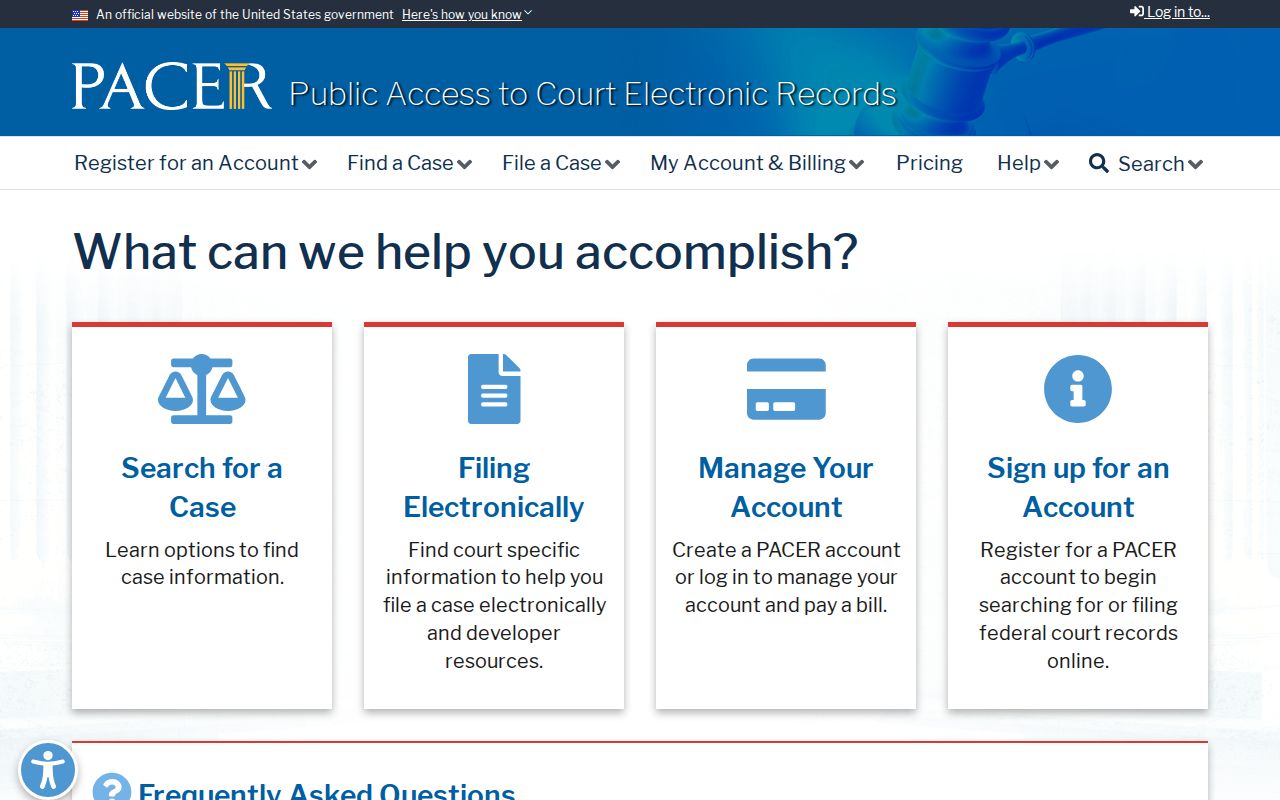
Use the federal case number and District of Colorado court selection so a similar name does not pull unrelated jurisdictions.
The District of Colorado courthouse listing places the Durango location at 1060 East Second Avenue, Suite 150, inside the La Plata County Courthouse.
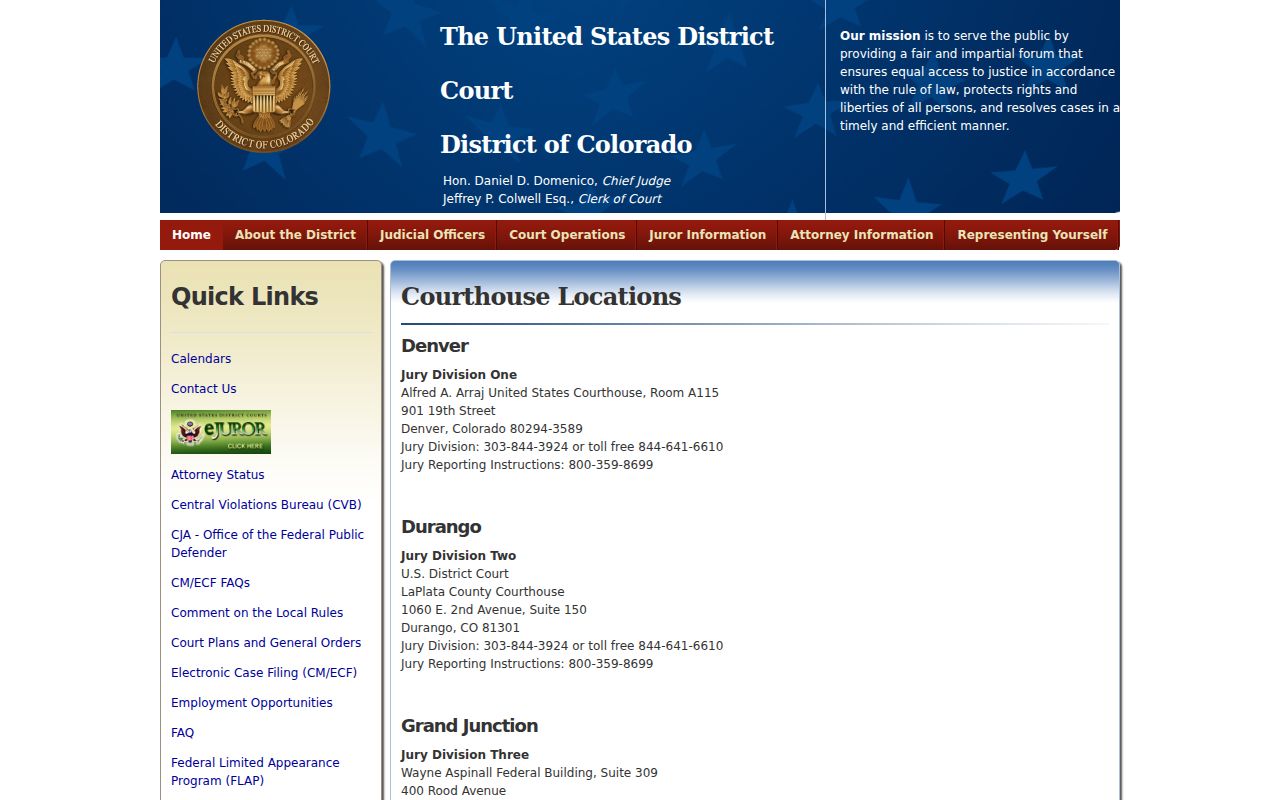
That Durango federal location does not replace the Cortez clerk for Colorado District or County Court files.
Montezuma DUI Court Records
The 22nd Judicial District operates an accredited DUI Court begun in 2007 for eligible repeat impaired-driving cases. Participation is voluntary and requires probation eligibility. Program activity can appear through the underlying criminal file, review hearings, probation-related entries, and sentence conditions rather than through a separate public name-search portal.
Program materials describe assessment, treatment, abstinence monitoring, probation contact, court review, and jail or work-release components. The district reports that Drug Court is inactive, so the existence of DUI Court should not be generalized to another specialty docket.
Access and Restrictions
Colorado court records follow Chief Justice Directive 05-01, while criminal-justice custodians operate under the Colorado Criminal Justice Records Act. Public files can omit sealed matters, juvenile material, protected victim or minor information, full birth dates, Social Security numbers, and restricted protection-order details. A paper or clerk-produced copy may also contain redactions absent from an internal court view.
When a Montezuma County case does not appear, give the clerk the party identifiers and approximate filing period and ask whether the record is municipal, sealed, off-site, or otherwise restricted. Sealing limits ordinary public access but does not vacate a conviction, and authorized courts, prosecutors, and law-enforcement agencies can retain access under Colorado law.
Note: A docket entry, arrest, or filed charge is not itself proof of conviction; verify the signed disposition or register of actions.