
Arrest History in Montezuma County
Montezuma County arrest history is distributed among several custodians. The Sheriff’s Office, Cortez Police, Mancos Marshal, Colorado State Patrol, land-management agencies, and tribal or federal partners can create an arrest report. The Montezuma County Detention Center creates the booking slice when a person enters the jail. Montezuma Combined Courts later records filed charges and their outcomes, and the Colorado Bureau of Investigation aggregates qualifying fingerprint-supported arrest cycles.
Those files are related but not interchangeable. A police narrative explains the event; a booking record documents intake and custody; the court file shows what prosecutors filed; CBI history shows reported Colorado cycles. A summons without fingerprints may never reach CBI.
Finding an Arrest Without a Jail Roster
No official public Montezuma inmate-search portal, daily arrest blotter, or mobile app was located. Begin with the detention telephone for current-custody confirmation, but recognize that the official pages display conflicting numbers, 970-564-4995 and a link resolving to 970-564-4971. For a durable record, contact MCSO Records at 970-564-4965.
Official fallback: ask Records for the $2.50 booking report and mugshot product or the $10 incarceration history, then request the incident report from the arresting agency.
A missing online entry proves nothing because no official person-level roster exists. VINELink may provide custody notifications, and the Colorado Department of Corrections locator becomes relevant only after transfer to state custody.
When the person may already have been released, ask for incarceration history rather than current-custody confirmation alone. That product can preserve admission and release information after a telephone inquiry no longer locates the person. Pair a county booking product with the arresting agency narrative. For an event on tribal, federal, park, forest, or state land, request that narrative from the creating agency because MCSO may hold only the jail intake slice.
How to Look Up Montezuma County Arrests
A complete search follows the record from the event through booking and prosecution. Use dates, location, agency, incident number, booking number, and full identity details when available.
- Call the detention center to ask about current custody; confirm the number before relying on it.
- Request the booking report or incarceration history from MCSO Records or NextRequest.
- Identify the arresting agency and request its incident or arrest narrative.
- Check the official Colorado docket after filing, then request the complaint and disposition from Combined Courts.
- Use CBI ICHC only for fingerprint-supported Colorado history, understanding its omissions.
This sequence covers the county counter, electronic request, telephone route, arresting-agency channel, court clerk, and statewide repository. A broad request can increase research and redaction cost, so name the record type and event.
For a warrant-based arrest, contact the issuing court as well. Montezuma County has no public warrant database, and the state docket is not a warrant search. Ask whether the warrant remains active, which case owns it, what appearance or bond directions apply, and how clearance will be documented. A municipal bench warrant may remain with a municipal authority rather than Combined Courts.
MCSO NextRequest for Arrest Reports
The official MCSO NextRequest portal accepts electronic public-record requests when no public database supplies the record.
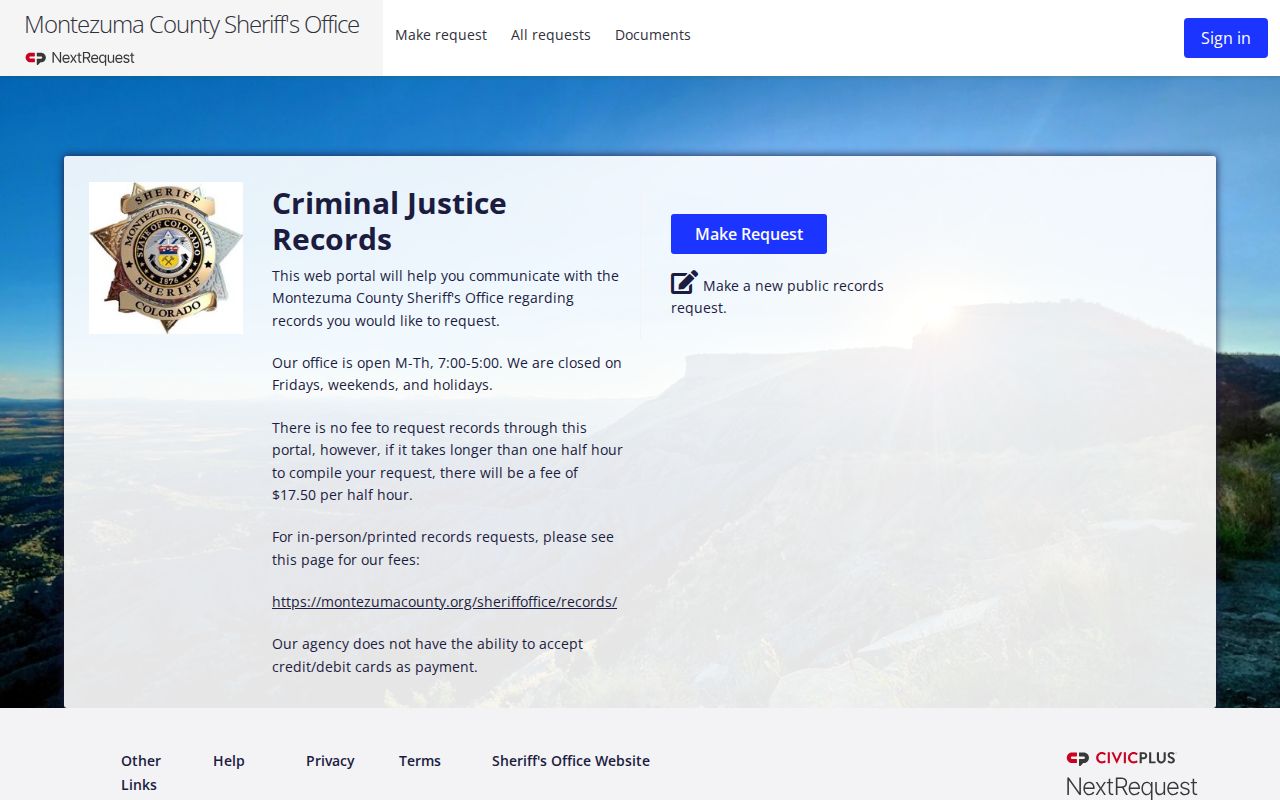
The portal provides a submission channel, not an instant arrest index; staff still review scope, redactions, and applicable CCJRA restrictions.
Give the incident date, location, involved party, arresting agency, and case or booking number. Choose electronic delivery where practical and request a cost estimate before a large compilation.
What an Arrest Record Shows
Public content varies with the creating agency and the need to protect victims, minors, active investigations, and security information. Typical arrest and booking fields answer separate parts of the event.
| Event details | Date, time, location, responding agency, and incident number. |
|---|---|
| Alleged charges | Offenses cited at arrest, which may change after prosecutor review. |
| Warrant basis | Issuing court and warrant reference when publicly releasable. |
| Booking details | Booking number, intake time, photograph, and fingerprint transaction. |
| Custody and bond | Initial release authority, bond information, and release date where public. |
| Redactions | Protected identities, medical/security details, and sealed information are omitted. |
Booking at 730 East Driscoll
The Montezuma County Detention Center at 730 East Driscoll Street was built in 2001 for 104 people. Its official description says ordinary occupancy is around 90 percent and has reached 143 percent.
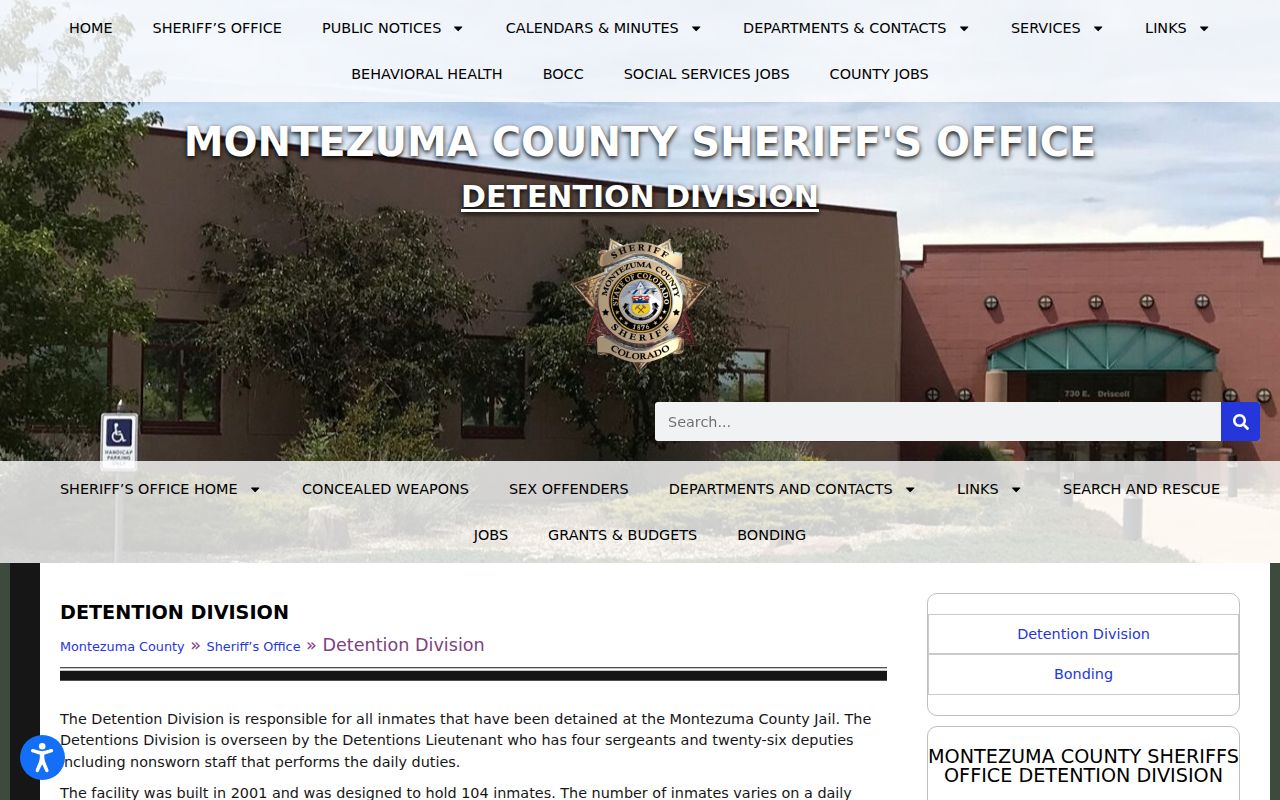
That facility creates custody records for pretrial people, county-sentenced inmates, parole violators, and some people awaiting transfer, but it does not publish a person-level roster.
Policy describes intake as paperwork review, property search and inventory, fingerprinting and photography, recording the reason for incarceration and release authority, medical and behavioral screening, housing assignment, movement logs, and court transport. Public products do not expose medical or security housing flags.
Recent Arrests and Booking Logs
Official monthly jail reports are the public aggregate substitute for a daily blotter. The June 2024 report counted 143 people confined during the month: 115 in the state category, 25 Cortez municipal prisoners, and 3 DCSO prisoners. The year-to-date total was 745. An April 2025 report counted 145, including 116 state, 27 Cortez municipal, and 2 DCSO prisoners.
These reports count groups and periods, not named people. A zero for Mancos or Dolores in one cited month does not mean no arrests occurred, no booking relationship exists, or no individual record can be requested. Use the monthly report for operational context and MCSO Records for a particular booking.
The 104-bed design and documented peak help explain why the jail administers alternatives such as work release, home detention, day reporting, weekends, and useful-public-service arrangements. Those programs concern custody administration, not guilt. A monthly count can include pretrial people, county-sentenced inmates, parole violators, and people awaiting transfer to the Colorado Department of Corrections, so it must not be described as a conviction count.
Monthly jail reports are useful for scale, but they are not person-level search tools. The June 2024 report counted 143 people confined during the month: 115 in the state category, 25 Cortez municipal prisoners, and three in the DCSO category. An April 2025 report counted 145, including 116 state and 27 Cortez municipal prisoners. A zero beside Mancos or Dolores for one month means only that the report counted no prisoner in that category during that period. It does not prove that no arrest occurred, that no citation was issued, or that the agency lacks a booking route.
For a named event, call the detention facility and then request the specific MCSO product. Ask the arresting agency for its narrative as a separate record. Official aggregate reports intentionally avoid becoming a gallery of people, and this page does not republish names or booking photographs.
The MCSO Records Counter
The Sheriff’s Records office is the principal county fallback for booking products and sheriff-created reports.
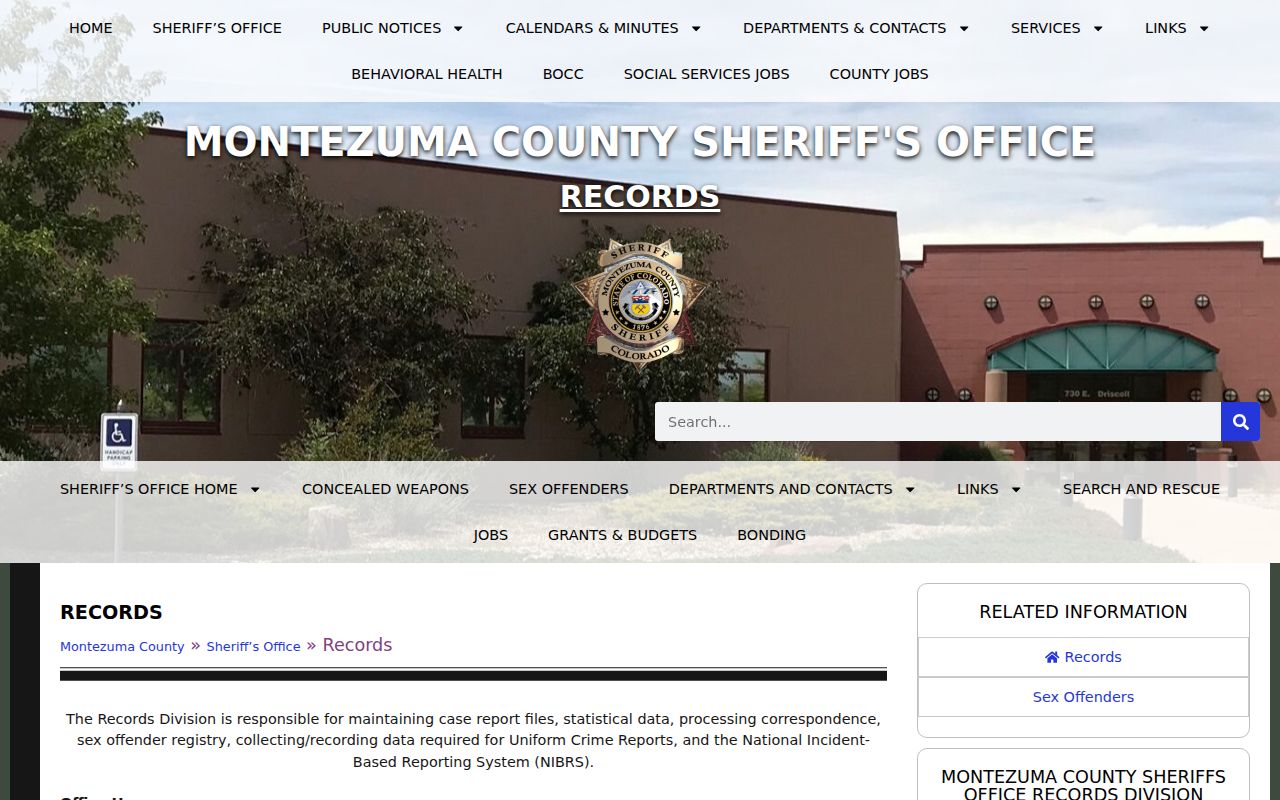
The counter’s posted hours and product list make it the reliable route when a public roster is unavailable.
MCSO Records
730 E. Driscoll St.
Cortez, CO 81321
970-564-4965
Monday-Thursday, 7:00-5:00
| Product | Posted amount |
|---|---|
| Victim report copy | Free |
| Paper copy | $0.25/page |
| Redaction | Additional $0.25/page |
| Booking report and mugshot | $2.50 |
| Incarceration history | $10 |
| Large request labor | $35/hour after free threshold |
Three Custodians After a Cortez Arrest
A Cortez Police arrest illustrates the county routing problem. Cortez Police Records at 608 North Park keeps the officer-generated report and requires a signed form obtained from staff. If the person is booked, MCSO keeps the jail record. A municipal ordinance charge goes to Cortez Municipal Court, while a state misdemeanor or felony goes to Montezuma Combined Courts.
| Record | First official contact | What it answers |
|---|---|---|
| Cortez incident report | Cortez Police, 970-565-8441 | Police event and allegations |
| County booking | MCSO Records | Jail intake and custody |
| State prosecution | Combined Courts, 970-565-1111 | Filed charge and outcome |
Mancos Marshal handles its own narratives by phone or counter at 131 North Main. MCSO handles sheriff incidents in Dolores, including records routed through its Driscoll Street unit.
Colorado State Patrol records follow the state public-record channel, including the state crash-report route when applicable. National Park Service, U.S. Forest Service, Bureau of Land Management, Bureau of Indian Affairs, tribal law enforcement, and other federal partners retain the reports they create. Even if the county jail accepted the person, the booking office cannot supply an outside agency’s full investigation. Ask MCSO for the booking number, then take that identifier and the event date to the originating office.
The same split applies outside Cortez. A Mancos Marshal report begins with the Marshal at 131 North Main, while a county-jail intake record belongs to MCSO. Dolores has no separate police department listed, so sheriff-handled incidents begin with MCSO and may involve the Dolores substation. Colorado State Patrol, federal land agencies, tribal law enforcement, and other state agencies keep the narratives they create even when the Montezuma jail holds the booking slice. Identifying the badge or agency name on the first document prevents a broad request from reaching the wrong custodian.
After prosecutors file a state charge, Montezuma Combined Courts becomes the source for the complaint, register of actions, and disposition. The free docket may help locate a scheduled hearing, but it is not an arrest log and does not contain the full case file.
Arrests vs Convictions
An arrest reflects probable-cause action or execution of a warrant. A conviction requires a guilty plea or verdict followed by judgment. Dismissal, acquittal, deferred judgment, or a prosecutor’s decision to file different charges can separate the booking allegation from the final court record.
| Point | Arrest record | Conviction record |
|---|---|---|
| Created by | Arresting agency and jail | Court |
| Core fact | Allegation and custody event | Judgment of guilt |
| Best document | Incident and booking reports | Disposition and sentence order |
| Can change? | Charges may be amended | May be appealed or later sealed |
Follow the matter into the Montezuma County criminal case file before describing an outcome.
Note: An arrest is not proof of guilt; verify each charge against the signed disposition from the responsible court.